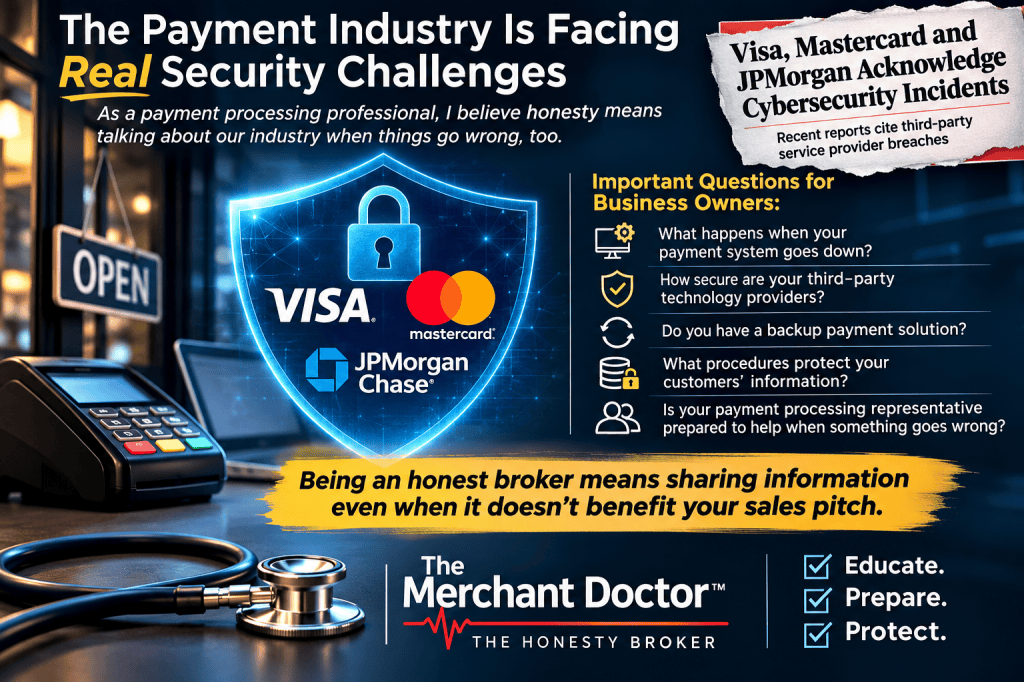
As a payment processing professional, I believe honesty means talking about our industry when things go wrong, too. Business owners deserve accurate information about the technology they depend on, not just a sales pitch about rates and equipment.
What happened on November 19, 2026?
Reuters reported that Visa, Mastercard and JPMorgan Chase acknowledged security incidents involving outside service providers. Visa said its own systems and payment-card data were unaffected. Mastercard described limited exposure of email addresses associated with a benefits program and said its network remained operational. JPMorgan said vendor-held marketing information may have been accessed and distinguished the incident from its earlier software-related outage.
A cyber extortion group claimed responsibility, but Reuters could not authenticate the posted datasets. The full scope of the incidents remains uncertain. There is no established connection to the recent aviation and other technology outages.
A data breach is not the same as a payment network outage
Confidentiality and availability are different security concerns. Stolen contact details can enable convincing phishing messages even when card authorizations continue normally. Conversely, a software fault can interrupt payments without exposing customer information. Both deserve contingency planning, but neither should be misrepresented.
Five questions every business owner should ask
1. What happens if my POS or payment processor becomes unavailable? Identify whether the failure is local, internet-related or upstream before taking action.
2. Do I understand my third-party providers? Review who can access customer information, what they retain and how incidents are communicated.
3. Do I have a tested backup payment method? Consider an independently connected terminal or approved alternative payment channel; understand shared processor dependencies and offline transaction risks.
4. How do I protect customer information? Use multifactor authentication, individual staff accounts, least-privilege access and approved payment equipment. Never record full card numbers or security codes as a workaround.
5. Who will help when something goes wrong? Establish escalation contacts, settlement reconciliation procedures and a clear incident response plan.
Practical steps to take today
Verify unexpected requests to change bank details or reset credentials through known support channels. Reconcile deposits with transaction reports, train staff to recognize phishing, and test backup connectivity before the next busy shift. If your processor offers offline payments, confirm eligibility, limits and the risk of later declines before enabling them.
The responsibility of an honest broker
No financial institution or technology provider can guarantee uninterrupted service or absolute security. A merchant services representative should help businesses understand those limitations before an incident, not disappear when one occurs.
Being an honest broker means sharing information even when it doesn’t benefit your sales pitch.
Educate. Prepare. Protect. That is the Merchant Doctor™ philosophy at Business Eye Network™.
Sources and further reading
Reuters — November 19, 2026: third-party vendor cyberattacks
The Wall Street Journal — November 19, 2026: customer data exposure
Associated Press — earlier banking service disruption
Reporting reflects information available on November 19, 2026. The underlying investigations may yield additional findings.


Leave a Reply