Business Eye Network™ | The Merchant Doctor™
Just because your point-of-sale system still works doesn’t mean it’s keeping up with your business.
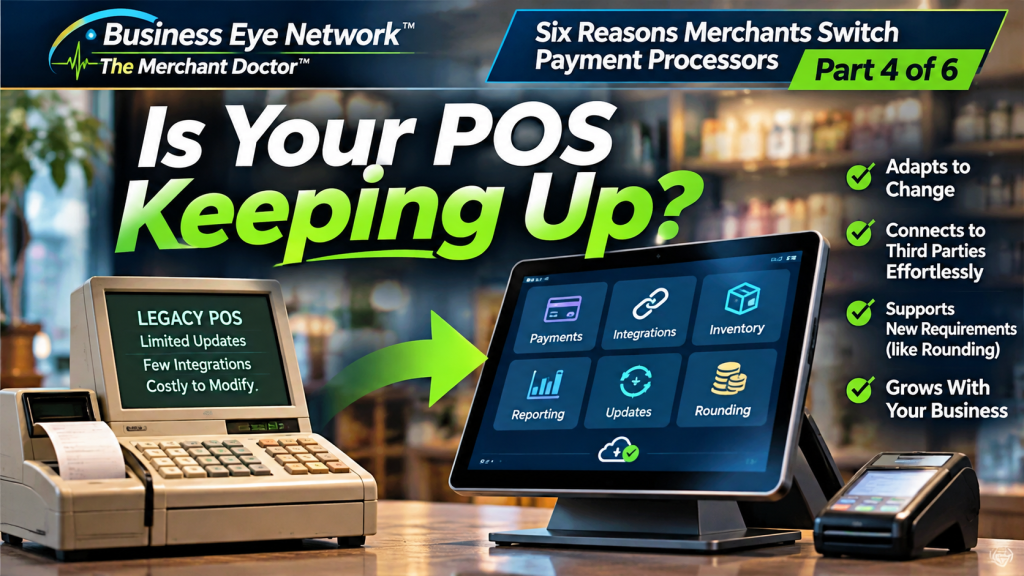
Today’s POS systems need to do considerably more than accept payments, print receipts, and track sales. They need to integrate with third-party applications, provide meaningful reporting, and adapt to an increasingly complex business environment.
The technology a merchant invests in today needs to be capable of evolving tomorrow.
Technology Should Adapt, Not Become Obsolete
Think about how frequently smartphones and computers receive operating system updates. New features, security improvements, and compatibility enhancements are introduced regularly. Why should a POS system be any different? Unfortunately, many older payment systems were built on platforms that weren’t designed for continuous improvement. Introducing new functionality can become difficult, expensive, or sometimes impossible. And when that happens, merchants can find themselves replacing equipment that otherwise works perfectly well.
The Disappearing Penny Is a Perfect Example
With the United States ending production of new pennies in 2025, businesses are increasingly facing the need to round cash transactions to the nearest nickel. Sounds simple, but what happens when a POS system isn’t designed to accommodate rounding? Cash transactions may need adjustments while electronic payments remain exact. Sales taxes must still be calculated correctly, and end-of-day reports need to reconcile. Without the appropriate software capabilities, a seemingly minor change can create significant accounting headaches. Existing pennies remain legal tender, and businesses should follow applicable local rounding requirements. And rounding is just one example of how quickly business requirements can change.
Integration Shouldn’t Be Complicated or Expensive
Modern businesses depend on third-party applications for inventory management, payroll, accounting, scheduling, online ordering, and much more. A POS system should connect to these applications easily and at a reasonable cost. Merchants shouldn’t need expensive custom development or multiple workarounds just to get their systems communicating. Your POS should be the central hub of your business, not a barrier to improving it.
The Merchant Doctor’s Perspective
At Business Eye Network, we believe merchants should evaluate payment technology based on more than what it can do today. The right system should offer ongoing software updates, practical integrations, and the flexibility to accommodate changing business needs. A POS system that processes payments successfully isn’t necessarily a system that’s helping your business operate efficiently. Before investing in new payment technology, ask your provider one important question: “Will this system be able to keep up with my business five years from now?” Sometimes merchants don’t leave their payment processor because of rates or service. They leave because their technology has stopped moving forward.
Part 4 of 6 — Six Reasons Merchants Switch Payment Processors


Leave a Reply