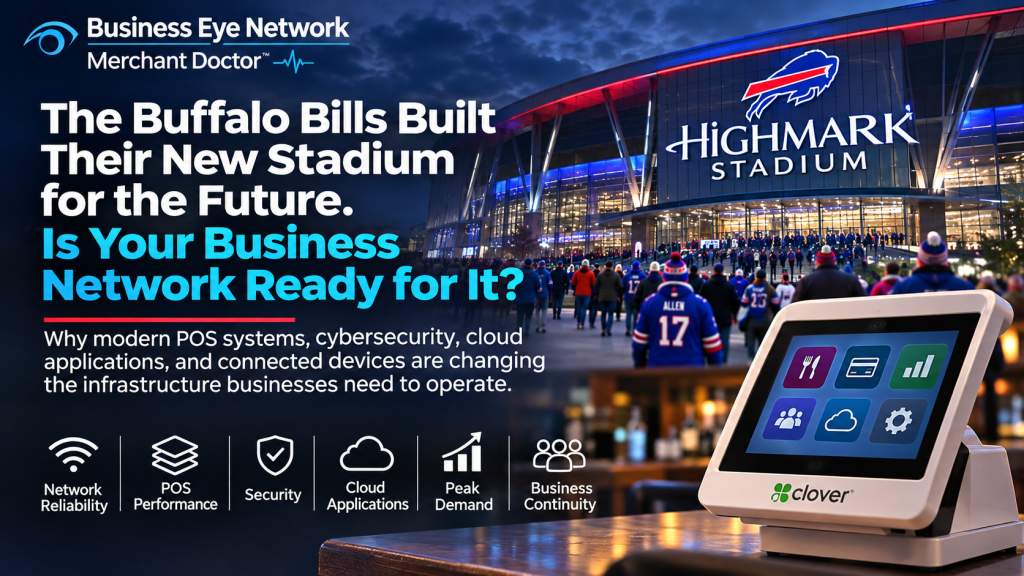
Why modern POS systems, cybersecurity, cloud applications, and connected devices are changing the infrastructure businesses need to operate.By Business Eye Network | Merchant Doctor™
A New Stadium. A Different Approach to Technology.
As a lifelong Buffalo Bills fan, I was particularly interested in a recent Cisco case study examining the technology infrastructure behind the team’s new Highmark Stadium.
The stadium opened in 2026, representing a massive investment in the future of the franchise. But one of its most impressive features isn’t necessarily something fans will see.
It’s the network operating behind the scenes.
According to Cisco, the stadium was engineered to accommodate approximately 80,000 simultaneous device connections, despite having seating for just over 60,000 fans.
The organization deployed an integrated infrastructure incorporating Wi-Fi 7, network switching, cybersecurity, broadcast technology, and centralized monitoring.
And perhaps most importantly, the system was designed around peak demand, not average usage.
That distinction caught my attention.
Because the same principle applies to businesses operating on a much smaller scale.
Your Restaurant Has Its Own Version of Game Day
Consider a busy restaurant on a Friday evening.
The dining room is full. The bar is packed. Customers are watching sporting events on multiple televisions.
Meanwhile:
- Servers are entering orders through wireless POS terminals.
- Kitchen printers and display systems are processing tickets.
- Credit card terminals are requesting authorizations.
- Customers are connecting to guest Wi-Fi.
- Music and entertainment systems are streaming content.
- Security cameras and other connected devices are operating.
- Cloud applications are exchanging information with remote servers.
All of these systems may be operating simultaneously.
And increasingly, they’re sharing the same underlying network infrastructure.
The question is no longer simply whether a restaurant has internet access.
The question is whether its infrastructure can reliably support everything the business expects it to do.
Modern POS Systems Are No Longer Just Cash Registers
For years, payment processing equipment operated relatively independently of other business systems.
Traditional credit card terminals connected through telephone lines or relatively simple internet connections.
Today’s point-of-sale systems are substantially different.
Platforms such as Clover and Toast offer integrated ecosystems involving payment processing, inventory management, employee management, online ordering, reporting, third-party integrations, and cloud-based applications.
Clover, for example, operates on an Android-based architecture with an extensive application marketplace.
That creates tremendous opportunities for business owners.
But it also introduces new considerations involving network reliability, security, software dependencies, and device management.
It’s important to understand that a modern POS system does not necessarily require enormous amounts of bandwidth.
A credit card authorization itself generally involves a relatively small amount of data.
However, the environment surrounding that transaction may be much more complex.
The real challenge is ensuring that critical business applications continue functioning reliably when competing network traffic increases.
Is 100 Mbps Enough for a Restaurant?
This is a question more business owners should be asking.
And the answer isn’t necessarily yes or no.
A properly engineered 100 Mbps connection may be perfectly adequate for one restaurant.
Another restaurant with the same advertised internet speed may experience recurring problems.
Why?
Because internet speed is only one component of network performance.
Other considerations include:
1. Latency: How quickly information travels between devices and external systems.
2. Packet loss: Whether information is being lost during transmission.
3. Network congestion: Whether multiple devices are competing for available capacity.
4. Traffic prioritization: Whether critical applications receive appropriate treatment during busy periods.
5. Firewall and security configuration: Whether security systems are properly configured without unnecessarily interfering with legitimate business traffic.
6. Wireless network design: Whether devices maintain consistent connectivity throughout the establishment.
7. Upload capacity: Whether the business has sufficient bandwidth in both directions.
A business purchasing a 100 Mbps internet plan may not understand whether that represents download speed alone or a symmetrical connection.
And even when the advertised speed is sufficient, internal network equipment or configuration issues can create bottlenecks.
The Lesson From Buffalo: Build for Your Busiest Day
One of the most interesting aspects of Cisco’s Highmark Stadium project is the decision to engineer capacity beyond the stadium’s seating capacity.
The Bills weren’t designing their infrastructure around an ordinary Tuesday afternoon.
They were designing it around tens of thousands of people using connected services simultaneously during major events.
That’s an important lesson for restaurants, retailers, entertainment venues, and other businesses.
A restaurant network shouldn’t be evaluated exclusively at 10 a.m. when the building is empty.
It needs to perform at 7 p.m. on a Friday when every system is working.
And it needs to perform consistently.
A payment terminal that works 99% of the time might sound reliable.
But for a busy merchant, even occasional failures during peak operating hours can disrupt service, frustrate customers, and create unnecessary work for employees.
Should Internet Infrastructure Be Part of Every POS Consultation?
I believe the answer is increasingly yes.
For years, payment processing consultations have focused primarily on transaction volume, processing rates, equipment, software features, and monthly costs.
Those remain important considerations.
But they’re no longer sufficient by themselves.
Before recommending a modern point-of-sale system, providers should also understand the environment in which that system will operate.
That means asking questions such as:
- Who provides your internet service?
- What are your contracted download and upload speeds?
- What are you paying each month?
- Do you have a secondary connection or backup?
- How many connected devices operate during peak hours?
- Are guest Wi-Fi and business-critical systems properly separated?
- Who manages your firewall, network switches, and wireless access points?
- How are network problems monitored and resolved?
These questions shouldn’t automatically disqualify a merchant from upgrading their POS.
Instead, they should help identify whether additional infrastructure improvements are necessary before deployment.
A merchant shouldn’t discover those requirements after installing a new system.
The Hidden Cost of Modernization
Business owners understandably want to reduce operating expenses.
They compare processing fees, POS subscriptions, equipment costs, and support agreements.
But there’s another cost that deserves consideration.
The infrastructure required to operate modern technology reliably.
Sometimes that means upgrading an internet connection.
Sometimes it means replacing outdated networking equipment.
Sometimes it means implementing better traffic management, wireless coverage, or security controls.
And sometimes the existing infrastructure is perfectly adequate, but its configuration needs attention.
The goal shouldn’t be to sell every merchant a more expensive internet plan.
The goal should be to identify what the business actually needs and ensure that the technology works when it matters most.
A Changing Responsibility for Merchant Services Professionals
I believe this represents an important shift in our industry.
Merchant services professionals can no longer afford to understand only transaction rates, equipment pricing, and processing statements.
As point-of-sale technology becomes increasingly integrated with daily business operations, the responsibilities surrounding deployment and support become more complex.
That doesn’t mean every payment consultant needs to become a network engineer.
It does mean recognizing when network expertise is necessary and building relationships with qualified technology partners.
A successful POS installation should involve more than plugging in equipment and processing a test transaction.
It should involve understanding the business, its technology dependencies, its peak operating conditions, and its long-term needs.
What the Buffalo Bills Got Right
The new Highmark Stadium represents a much larger technology investment than most businesses will ever need.
But the underlying philosophy is relevant at every level.
The Bills built their technology infrastructure around reliability, security, visibility, and future demand.
Restaurants and small businesses should approach their own technology decisions with similar priorities, scaled appropriately to their operations and budgets.
Because whether you’re processing payments at a neighborhood restaurant or supporting tens of thousands of fans at an NFL stadium, one principle remains the same:
Your technology is only as dependable as the infrastructure supporting it.
And when that infrastructure fails, the entire customer experience can suffer.
At Business Eye Network, we believe evaluating payment technology means looking beyond the transaction itself.
It means understanding the complete operating environment and helping merchants make informed decisions about the systems their businesses depend on.
That’s what modern merchant services consulting should look like.
Business Eye Network | Merchant Doctor™
Helping businesses evaluate payment processing, point-of-sale technology, operational costs, and the infrastructure behind them.
Source: Cisco, A Blank Slate in Buffalo: How the Bills Built the NFL’s First Complete Wi-Fi 7 Stadium, October 21, 2026.


Leave a Reply