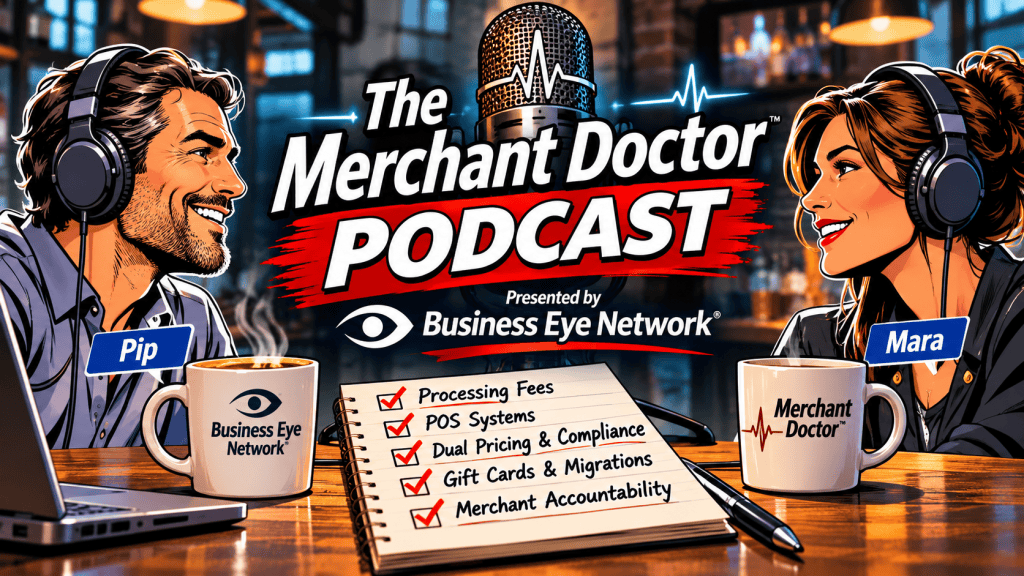
Pip: Welcome to Business Eye LLC — where the question is never just “what’s the rate?” and the answer is always “it’s more complicated than that.” Joe Wilkins has been busy this week.
Mara: He has. The posts cover payment pricing strategy, the hidden risks of switching POS systems, and what merchant accountability actually looks like after a major industry lawsuit.
Pip: Three topics, one through line: the thing you didn’t ask about is usually the thing that costs you.
Mara: Let’s start with processing fees and what it really means to build a payment strategy.
Processing Fees And Pricing Strategy
Pip: The instinct when fees feel high is to go hunting for a lower rate. These posts argue that instinct is often aimed at the wrong target.
Mara: The dual pricing piece puts it directly: “The best payment strategy isn’t necessarily the one that produces the lowest possible cost on every transaction. It’s the one that provides transparency, supports the business’s operations, and gives customers meaningful choices.”
Pip: So the goal isn’t to squeeze every transaction — it’s to structure the whole thing so customers understand their options and the business isn’t hemorrhaging money on the wrong payment method.
Mara: That’s the upshot, yes. The post on why processing fees run high makes the same case from a different angle — a business processing $100,000 monthly might see a quoted rate of 2.50% but an effective rate of 2.825% once gateway fees, batch fees, and network charges stack up.
Pip: And then software subscriptions walk in and sit down uninvited.
Mara: Right — POS platforms today carry recurring costs for scheduling, loyalty programs, online ordering, and integrations. The post illustrates a restaurant paying $650 monthly in software alone, then asks whether a competitor’s processing savings actually offset that.
Mara: ACH gets its own section too. On a $15,000 invoice, card acceptance at 2.9% runs $435. An ACH option at $10 saves $425 on that single transaction.
Pip: Which is why the framing shifts from “how do we lower the card rate” to “is a card even the right method here.”
Mara: Exactly. And for businesses accepting commercial cards, qualifying transactions correctly under programs like Visa’s Commercial Enhanced Data Program can matter more than shaving basis points off the processor markup.
Pip: The takeaway across both pieces is the same: stop shopping for rates, start evaluating strategy — because the rate is one line on a statement that has a lot of other lines.
Mara: That question of what you’re actually paying for carries directly into what happens when you decide to swap the system generating those payments.
POS Migration And Gift Card Risk
Pip: Switching POS systems sounds like an operational upgrade. This post is here to tell you about the $14,000 problem you forgot to ask about.
Mara: The post on changing POS systems frames it plainly: “A successful POS transition isn’t simply one where the new equipment turns on and processes a credit card. It’s one where the business continues operating without unnecessarily disrupting its customers.”
Pip: And gift cards are the disruption hiding in plain sight. The outstanding balance doesn’t evaporate because you signed a new agreement.
Mara: The post walks through exactly why. Gift card balances may live with your POS software provider, your payment processor, a third-party gift card company, or a proprietary platform — and none of those automatically talk to your new system.
Pip: So the new terminal accepts Visa flawlessly and stares blankly at a card someone bought their grandmother for Christmas.
Mara: The post puts numbers to it. A restaurant with 400 active cards averaging $35 each carries $14,000 in outstanding obligations. If each redemption requires five extra minutes of staff time because the systems don’t communicate, that’s roughly 16 additional labor hours — around $333 at an illustrative $20-per-hour loaded cost, before you count customer frustration or accounting errors.
Mara: There are migration paths — exporting balances, maintaining the old platform temporarily, manual redemption workflows, or independent third-party gift card solutions that support multiple POS systems. But compatibility has to be verified before the switch, not discovered during a busy Saturday service.
Pip: The post also flags federal law: covered consumer gift cards generally can’t have their funds expire for at least five years. Changing vendors does not change that obligation.
Mara: Seven specific questions are listed for any merchant evaluating a new POS — including whether existing physical cards will still scan, what the alternative redemption process is if they won’t, and whether you can test real cards before go-live.
Pip: The framing is sharp: ask whether gift cards are “supported” and ask whether your existing gift cards and their outstanding balances are supported. Those are two very different questions.
Mara: Which is really a question about what a provider owes you — and who stays accountable after the contract is signed.
Merchant Accountability And Transparency
Pip: The FTC lawsuit against Toast is the news hook, but the post pivots fast to a harder question aimed squarely at the whole industry.
Mara: The post on the Toast lawsuit asks it directly: “Will we hold ourselves and the products we represent to the same standards we’re demanding from Toast?”
Pip: That’s the piece that gives the post its weight. The lawsuit alleges hidden fees, unauthorized subscriptions, misleading equipment offers, and difficult cancellations — but the argument is that none of those practices are unique to one company.
Mara: The post lays out a six-point accountability check covering financial transparency, authorization and consent, equipment ownership terms, contractual exit conditions, customer support expectations, and long-term relationship ownership. The standard on transparency is explicit: no surprises when the first statement arrives.
Mara: There’s also a distinction drawn between a referral arrangement and an ongoing advisory relationship — a referral fee compensates someone for an introduction, but it doesn’t create continued responsibility to the merchant after the agreement is signed.
Pip: The closing challenge is directed inward: if you’re criticizing a competitor for undisclosed fees, have you reviewed the termination provisions in the products you represent?
Mara: Toast disputes the allegations and the case is pending — the post is careful to note that. But the practical advice doesn’t wait for a verdict: merchants can review their agreements today, request written explanations of recurring charges, and ask one question before signing anything — who is accountable to me after I sign?
Pip: Rate, migration, accountability — three different entry points, same destination: understand what you’re actually agreeing to before you agree to it.
Mara: And ask the questions that don’t appear on the proposal. That’s the thread running through all of it.
Pip: More from Business Eye LLC next time — bring your statements.


Leave a Reply